6-Week Bodyweight Bootcamp: No Equipment Home Workout Plan
A structured 6-week bodyweight program with three progressive phases, real modifications, and warmup routines. No equipment, no gym, just a plan that works.
 Jeff·Aug 20, 2024·9 min read
Key Takeaways
- The program uses three progression phases over 6 weeks that change movement quality, tempo, and explosiveness rather than just adding more reps.
- Phase 1 focuses on building clean movement patterns with basic exercises and proper form, while Phase 2 cranks up difficulty with slower tempos and supersets using the same movements.
- Phase 3 switches to explosive plyometric work like clap push-ups and jump squats to build power and conditioning.
- You literally only need floor space to lunge and something to prop your feet on like a couch for the advanced progressions.
- The warmup takes 6 minutes every session and includes joint circles, movement prep, and activation exercises to prevent injury.
Get a Free AI Coach on WhatsApp
Ask questions, get workout plans, and track your progress — all from WhatsApp.
Message Your CoachYou don't need a gym to get strong. You don't even need a pull-up bar. What you need is a structured plan that actually progresses -- not just "do more push-ups each week" but real changes in movement patterns, tempo, and difficulty that force your body to adapt.
This is a 6-week bodyweight program split into three 2-week phases. Each phase changes the *type* of challenge, not just the volume. You'll go from building movement quality, to adding time under tension and supersets, to explosive plyometric work. The whole thing runs on three to four sessions per week, and all you need is enough floor space to do a lunge.
Why bodyweight training works
Bodyweight exercises are compound by default. A push-up works your chest, shoulders, triceps, and core all at once. A lunge hits your quads, glutes, and challenges your balance. You're not isolating muscles on a machine -- you're training movement.
There's a practical benefit too: the loading is self-regulating. A 200-pound person doing push-ups is pressing more absolute weight than a 140-pound person. Your body scales the resistance automatically.
The tradeoff is that progression is harder to measure than just adding plates to a bar. That's why this program uses multiple progression methods -- tempo changes, movement upgrades, superset pairings, and plyometrics -- instead of just piling on reps.
What you need before starting
- •Space: Enough room to lunge forward and lie flat with arms overhead. A living room with the coffee table pushed aside works fine.
- •Surface: A yoga mat or carpet. Hardwood floors are rough on your wrists and knees during floor work.
- •Timer: Your phone. You'll need it for timed holds and rest periods.
- •Something to elevate your feet: A couch, sturdy chair, or step. Used for decline push-ups and Bulgarian split squats in later phases.
That's it. No bands, no doorframe pull-up bar, no excuses about equipment.
The warmup (use this every session)
Do this before every workout. It takes about 6 minutes and gets your joints warm, your muscles firing, and your heart rate up enough to start working.
Joint circles (1 minute)
- •Neck circles: 5 each direction
- •Arm circles: 10 forward, 10 backward
- •Hip circles: 5 each direction per leg
- •Ankle circles: 5 each direction per foot
Movement prep (3 minutes)
- •Inchworms: 5 reps (walk hands out to plank, walk feet to hands, stand up)
- •World's greatest stretch: 3 per side (lunge, plant hand, rotate and reach)
- •Bodyweight squat to stand: 8 reps (squat deep, grab toes, straighten legs, stand)
Activation (2 minutes)
- •Glute bridges: 10 reps with a 2-second hold at top
- •Scapular push-ups: 8 reps (in plank, let shoulder blades pinch together then push apart)
- •Dead bugs: 6 per side (slow and controlled, lower back stays flat on the floor)
Phase 1: Movement quality (Weeks 1-2)
Goal: Build clean movement patterns, establish a training habit, identify weak points.
Frequency: 3 sessions per week (e.g., Monday / Wednesday / Friday)
Rest: 60 seconds between sets, 90 seconds between exercises.
Workout A (Push + Squat focus)
| Exercise | Sets x Reps | Notes |
|---|---|---|
| Push-ups | 3 x 8-10 | Full range: chest to floor, arms locked out at top |
| Bodyweight squats | 3 x 12-15 | Pause 1 second at the bottom of each rep |
| Pike push-ups | 3 x 6-8 | Hips high, head between arms, target shoulders |
| Reverse lunges | 3 x 8 per leg | Step back, not forward -- easier on the knees |
| Plank hold | 3 x 30 sec | Squeeze glutes, don't let hips sag or pike up |
Workout B (Hinge + Core focus)
| Exercise | Sets x Reps | Notes |
|---|---|---|
| Single-leg glute bridges | 3 x 10 per side | Drive through the heel, full hip extension |
| Bodyweight Romanian deadlift | 3 x 8 per leg | Stand on one leg, hinge forward, touch the floor if you can |
| Bear crawl | 3 x 30 sec | Knees 1 inch off the ground, move slow |
| Dead bugs | 3 x 8 per side | Opposite arm and leg extend, lower back flat |
| Side plank | 3 x 20 sec per side | Stack feet or stagger them, keep hips up |
Alternate A and B each session. Week 1 might be A-B-A, Week 2 would be B-A-B.
What to focus on: Don't rush reps. If you can't do a push-up with your chest actually touching the floor, that's fine -- work on the range you have. But own every inch of it.
Phase 2: Time under tension and supersets (Weeks 3-4)
Goal: Increase difficulty through tempo manipulation and paired exercises. Same movements, harder stimulus.
Frequency: 3-4 sessions per week (e.g., Monday / Tuesday / Thursday / Friday)
Rest: 45 seconds between superset pairs, 75 seconds between blocks.
Workout A (Push + Squat)
Superset 1 (3 rounds):
- •Tempo push-ups: 8 reps (3 seconds down, 1 second pause at bottom, push up)
- •Jump squats: 8 reps (squat to parallel, explode up, land soft)
Superset 2 (3 rounds):
- •Diamond push-ups: 6-8 reps (hands together under chest)
- •Walking lunges: 10 per leg (continuous, don't stop between legs)
Superset 3 (3 rounds):
- •Pike push-ups (feet elevated on couch): 6-8 reps
- •Wall sit: 30-45 seconds
Workout B (Hinge + Core)
Superset 1 (3 rounds):
- •Single-leg glute bridge with 3-second lower: 8 per side
- •Mountain climbers: 20 total (controlled, not frantic)
Superset 2 (3 rounds):
- •Tempo bodyweight RDL: 6 per leg (3 seconds down, 2 second pause at bottom)
- •Bear crawl: 40 seconds
Superset 3 (3 rounds):
- •V-ups: 10 reps
- •Side plank with hip dip: 8 per side
Why tempo changes matter: Slowing down the lowering phase (eccentric) increases time under tension without adding load. Your muscles don't know the difference between a heavy weight and a slow bodyweight rep -- they just know tension. A 3-second push-up eccentric turns 8 reps into 24+ seconds of work per set.
Phase 3: Power and plyometrics (Weeks 5-6)
Goal: Build explosive power and muscular endurance. Movements get more dynamic and demanding.
Frequency: 4 sessions per week (e.g., Monday / Tuesday / Thursday / Saturday)
Rest: 60 seconds between sets, 2 minutes between exercises.
Workout A (Explosive upper + squat)
| Exercise | Sets x Reps | Notes |
|---|---|---|
| Clap push-ups (or explosive push-ups) | 4 x 5-6 | Push hard enough to leave the ground, even if hands don't clap |
| Bulgarian split squats | 4 x 8 per leg | Rear foot on couch, go deep, drive up strong |
| Decline push-ups | 4 x 8-10 | Feet on couch, hands on floor |
| Squat jumps | 4 x 8 | Full squat depth, max effort jump, soft landing |
| Hollow body hold | 4 x 20-30 sec | Lower back pressed into floor, legs and arms off ground |
Workout B (Explosive hinge + core)
| Exercise | Sets x Reps | Notes |
|---|---|---|
| Broad jumps | 4 x 5 | Stand, hinge, jump forward as far as possible, reset each rep |
| Single-leg RDL to hop | 4 x 6 per leg | Hinge down, then explode up into a small hop |
| Burpees (no push-up) | 4 x 8 | Squat, jump feet back, jump feet in, stand and jump |
| Inchworm walkout | 4 x 8 | Walk hands out as far as you can, walk back |
| Lateral bounds | 4 x 6 per side | Jump sideways, stick the landing for 1 second |
Workout C (Full body circuit -- use once per week)
Perform 4 rounds, resting 90 seconds between rounds:
- •8 explosive push-ups
- •10 jump squats
- •8 burpees (no push-up)
- •10 reverse lunges per leg
- •30-second plank
This circuit should take 20-25 minutes including rest. It's a conditioning finisher, not a strength session.
The cooldown
Do this after every session. Takes about 5 minutes.
- •Downward dog to cobra flow: 5 slow reps (stretch the hamstrings and hip flexors)
- •90/90 hip stretch: 30 seconds per side (sit on floor, both legs at 90 degrees, lean forward)
- •Chest doorway stretch: 30 seconds per side (arm on doorframe, lean through)
- •Quad stretch: 30 seconds per leg (standing or lying on your side)
- •Child's pose: 30 seconds (sit back on heels, arms extended, breathe)
Don't skip this. Five minutes of stretching after training keeps you from turning into a stiff mess by week three.
Beginner modifications (real ones)
Just doing fewer reps of an exercise you can't perform correctly doesn't help. Here are actual regressions that let you build the strength to do the full movement.
Can't do a full push-up?
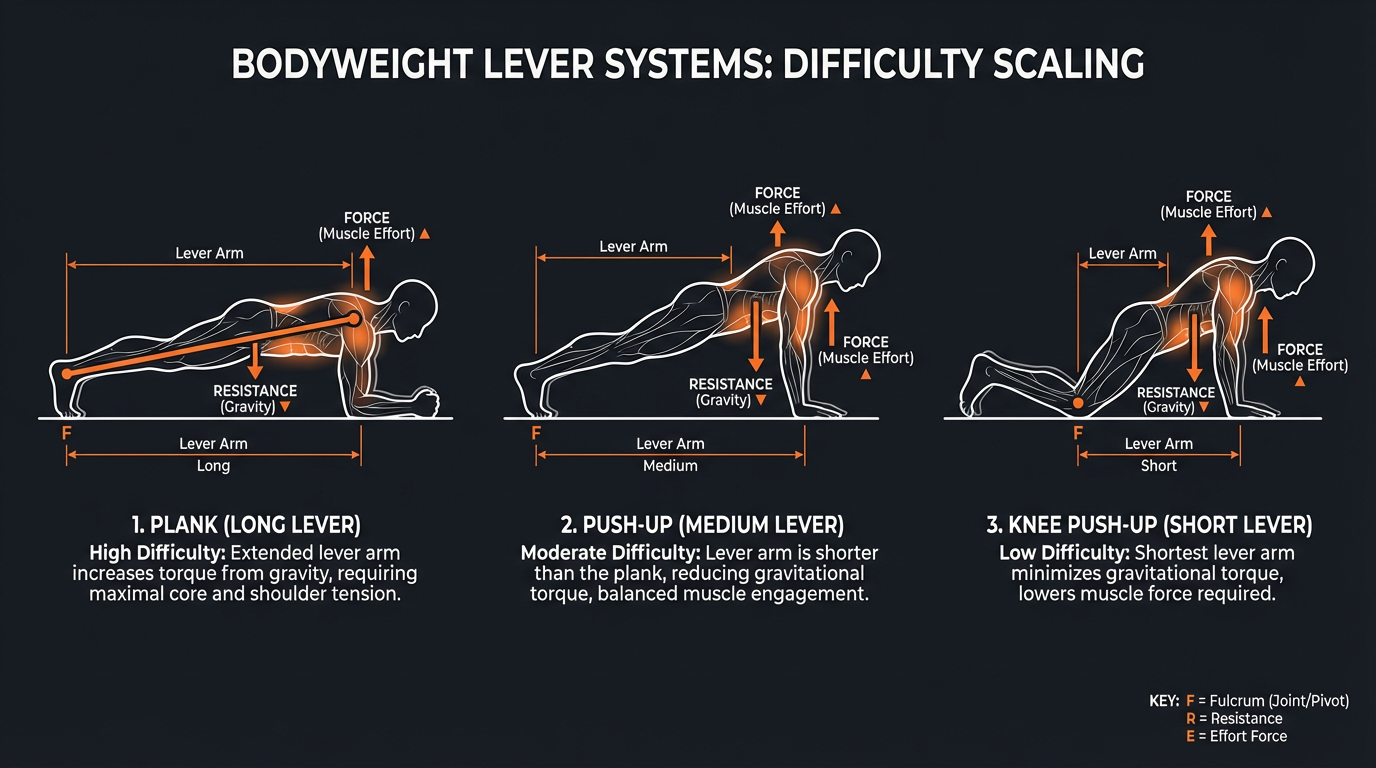
Do incline push-ups with your hands on a counter or sturdy table. This reduces the load to roughly 50-60% of your bodyweight (versus ~65-70% on the floor). As it gets easy, lower the surface: counter, then couch arm, then a stack of books, then the floor.
Squats feel unstable or you can't hit depth?
Hold onto a doorframe or the back of a chair and squat as deep as you can with control. The hand support lets you sit back further and build confidence in the bottom position. Also try box squats -- squat down to a chair, touch it lightly, stand back up. This gives you a depth target and a safety net.
Can't hold a plank for 30 seconds?
Do planks from your knees. But here's the important part: keep your hips in line with your shoulders and knees. Most people do knee planks with their butt sticking up, which takes the core out of it entirely. Squeeze your glutes and brace your abs like someone's about to poke you in the stomach.
Jumping exercises feel too hard on your joints?
Replace any jump with the same movement done fast but without leaving the ground. Instead of jump squats, do fast bodyweight squats with an aggressive stand. Instead of clap push-ups, do explosive push-ups where you push hard but keep your hands on the floor. You still get the intent to produce force -- just without the impact.
Single-leg exercises are wobbly?
Touch a wall or chair lightly with your fingertips. Use as little support as possible, but use enough to actually complete the reps without falling over. Balance improves fast once you practice it consistently.
Programming notes
How to progress within each phase: If you finish all sets and reps with clean form on the first session, add 1-2 reps per set next session. If you're struggling to complete the prescribed reps, stay at that level until you can.
When to move between phases: Finish the full two weeks of each phase before moving on, even if it feels easy by the end. The point of Phase 1 isn't just strength -- it's building movement patterns you'll rely on in Phases 2 and 3.
What if you miss a session? Pick up where you left off. Don't try to double up sessions to "catch up." The program works because of consistent moderate stress, not occasional huge efforts.
Tracking: Write down your reps each session. Even just noting "Workout A -- got all reps" or "Workout B -- failed on set 3 of single-leg RDLs" gives you something to measure against next time.
After the 6 weeks: You have a few options. Run the program again and aim to beat your numbers. Add a weighted vest or backpack with books (seriously, it works). Or transition to a gym program -- you'll have a solid movement foundation to build on.
FAQ
Is bodyweight training enough to build muscle?
Yes, up to a point. Research shows bodyweight training can produce meaningful hypertrophy, especially in beginners and early intermediates. The limiting factor is progressive overload -- once movements get too easy, you need harder variations or external load. This program handles that for six weeks. After that, consider adding resistance.
Can I do this program every day?
Don't. Your muscles grow during rest, not during training. The program is designed for 3-4 sessions per week because that's what allows adequate recovery. If you want to do something on off days, go for a walk or do the cooldown stretches. Don't add extra sessions.
I'm already pretty fit. Will this be hard enough?
Phase 1 might feel easy if you have training experience. That's fine -- use it to clean up your movement quality and really nail the tempo. Phases 2 and 3 will be harder than most people expect. Tempo push-ups and plyometric work are humbling even for experienced lifters.
What if I have bad knees/shoulders/back?
This isn't medical advice, but here's a general principle: if a specific movement hurts, find a variation that doesn't. Reverse lunges tend to be easier on knees than forward lunges. Incline push-ups reduce shoulder stress. Glute bridges and dead bugs are almost always well-tolerated for people with back issues. If pain persists, see a physio.
Do I need to follow a specific diet?
You don't need a meal plan, but your results will be better if you eat enough protein (roughly 0.7-1g per pound of bodyweight daily) and don't eat in a massive deficit. Bodyweight training burns fewer calories than most people think, so this program alone won't produce dramatic fat loss. It builds strength and muscle. Pair it with reasonable nutrition and you'll see real changes.
Frequently Asked Questions
- Can you build muscle with just bodyweight exercises?
- Yes, especially as a beginner or intermediate. Push-ups, pull-ups, dips, squats, and lunges build real muscle. The key is progressive overload through harder variations, more reps, and slower tempos — not just doing the same easy routine forever.
- How effective is a 6-week bodyweight program?
- Very effective for building a base of strength and muscle. Six weeks is enough time to see visible changes in your arms, chest, and legs if you're consistent and eating enough protein. Don't expect to look like a gym bro, but you'll look noticeably better.
- What's the best bodyweight workout schedule for beginners?
- Three to four days per week with at least one rest day between sessions. A push/pull/legs split or upper/lower split both work well. Don't train the same muscles on back-to-back days.
- How do I make bodyweight exercises harder without equipment?
- Slow down the eccentric (lowering phase) to 3-5 seconds, add pauses at the bottom, progress to harder variations (push-ups to archer push-ups to one-arm push-ups), or increase reps. Tempo manipulation alone can make basic exercises brutally hard.