If you want a bigger squat, a stronger bench, and visible muscle without living in the gym, StrongLifts 5x5 is one of the cleanest ways to do it.
It’s not “secret sauce.” It’s a simple loop:
- practice the big barbell lifts often
- use a manageable rep range (5s)
- add a little weight over time
- recover well enough to repeat
Do that for 8 weeks and you’ll almost always leave stronger (and usually noticeably more muscular) than you arrived.
Table of contents
- What StrongLifts 5x5 is (and who it’s for)
- Why 5x5 works for strength and muscle
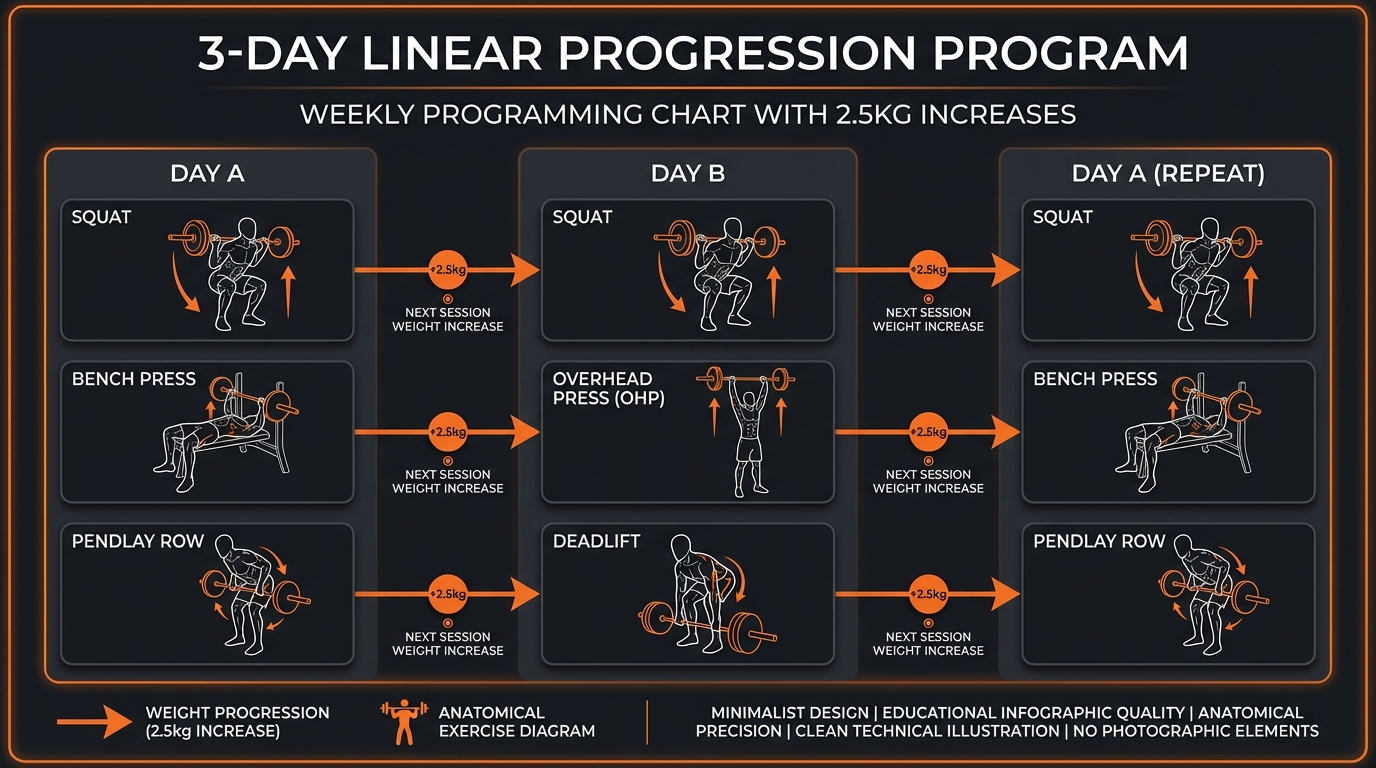
- The two workouts (A/B)
- Your 8-week plan (what to do each week)
- How to pick starting weights
- Warm-up that doesn’t waste time
- Progression rules: add weight, microload, deload
- Technique cues that prevent stalls
- Optional assistance work (if you want more muscle)
- Cardio, mobility, and recovery
- Nutrition for strength and size
- FAQ
- What to do after 8 weeks
What StrongLifts 5x5 is (and who it’s for)
StrongLifts 5x5 is a barbell program built around two alternating workouts, performed three days per week. Most lifts are 5 sets of 5 reps (“5x5”), while the deadlift is typically 1 heavy set of 5 reps after warm-ups.
It’s best for you if:
- you’re a beginner or “returning” lifter who wants a clear plan
- you want to get strong fast on the big compound lifts
- you prefer simple training you can stick to consistently
It’s not ideal if:
- you’re already very advanced and need slower, more complex progression
- you can’t currently train the barbell basics safely (no rack, no safe setup)
- you mainly want bodybuilding-style variety over performance on the main lifts
Why 5x5 works for strength and muscle
1) Heavy-ish reps build strength efficiently
Sets of 5 let you use relatively challenging loads while still getting enough total practice to improve technique. That combination is a great recipe for strength gains.
2) Compound lifts give you the most “return” per set
Squats, presses, rows, and deadlifts train a lot of muscle at once. You’re not chasing pump — you’re building capacity.
3) Progressive overload is baked in
The program is built around adding weight when you hit the reps. That’s the driver.
4) It’s time-efficient
Three sessions per week, a small list of lifts, repeatable structure. That’s a feature, not a limitation.
The two workouts (A/B)

You alternate Workout A and Workout B each time you train.
Workout A
- Squat — 5x5
- Bench Press — 5x5
- Barbell Row — 5x5
Workout B
- Squat — 5x5
- Overhead Press — 5x5
- Deadlift — 1x5 (after warm-ups)
Typical schedule:
- Week 1: A / B / A
- Week 2: B / A / B
…and so on.
Your 8-week plan (what to do each week)
StrongLifts is technically “workout-to-workout” progression (not a fixed week-by-week percentage plan). But for most people, an 8-week block looks like this:
Weeks 1–2: Learn the movements, build momentum
Goal: dial in technique and finish every session feeling like you could do more.
- Start conservative (you should have reps “in the tank”)
- Add weight each time you repeat a lift (if you hit all sets/reps with good form)
- Prioritise consistency: 3 sessions/week
Your focus checklist
- stable squat depth and bracing
- controlled bench setup (feet planted, consistent bar path)
- clean hip hinge and bar path on deadlifts
Weeks 3–6: Linear progression (the fun part)
Goal: keep stacking small wins.
- Continue adding weight as long as you complete the prescribed reps
- Rest longer between sets as it gets heavier (don’t rush)
- If you miss reps, follow the progression rules (below) instead of panicking
Reality check: this is where you’ll start to feel like it’s “training,” not “practice.” That’s fine — you just don’t want it to turn into daily max attempts.
Weeks 7–8: Microloading + smart recovery
Goal: keep progress moving when jumps start to feel too big.
- Use smaller weight increases on presses (and later, on other lifts)
- If you fail the same weight repeatedly, deload and build back up
- Keep technique tidy (heavy + messy usually equals stalled + sore)
How to pick starting weights
This is where most people mess it up. Start too heavy and the program feels “hard” in Week 1… and impossible by Week 3.
Use these rules:
If you’re new to barbell training
- start with the empty bar for squat/bench/overhead press
- start light on rows and deadlifts (a weight you can move perfectly)
If you’ve lifted before
Start with a weight you could do for around 10 reps on a good day — then use it for your 5x5 work sets. It should feel almost easy at first.
Warm-up that doesn’t waste time

A good warm-up does three jobs:
- raises temperature
- practices the movement
- ramps you to your work weight without fatigue
A simple barbell warm-up ladder looks like this (example for a 100kg squat work weight):
- 20kg x 5
- 20kg x 5
- 40kg x 5
- 60kg x 5
- 80kg x 3
- 100kg x 5x5 (work sets)
Don’t overthink rest during warm-ups. Move from set to set as you add plates.
Progression rules: add weight, microload, deload

This is the engine of StrongLifts. Keep it simple.
1) If you complete all sets and reps with good form
Add weight next time you do that lift.
2) If you miss reps
Repeat the same weight next time and aim to beat your previous performance (more total reps, cleaner sets).
3) If the jump is too big (especially on presses)
Microload: use smaller increases (fractional plates) so you’re adding the smallest repeatable amount.
4) If you fail the same lift for multiple sessions
Deload: drop the weight and build back up with better form and recovery.
Technique cues that prevent stalls
You don’t need a 30-page technique manual. You need a few cues that keep you consistent.
Squat
- brace first (big breath, ribs down)
- knees track over toes, keep mid-foot pressure
- hit consistent depth you can repeat
Bench press
- set feet first, then upper back tight
- touch the same spot on the chest each rep
- don’t let elbows flare wildly on the way up
Row
- hinge once, stay in position
- pull bar to lower ribs/upper stomach
- control the lowering phase
Overhead press
- squeeze glutes, ribs down (don’t lean back)
- bar travels close to face, then “through the window” overhead
- finish with biceps near ears
Deadlift
- bar over mid-foot, lats tight (“squeeze armpits”)
- push the floor away, don’t jerk the bar
- lock out tall, don’t overextend
Optional assistance work (if you want more muscle)
StrongLifts can build plenty of muscle on its own — but if your main goal is looking bigger (arms, upper body), a little assistance can help if it doesn’t wreck recovery.
Good additions (2–3 sets each, kept submaximal):
- Pull-ups (or pulldowns)
- Dips (or push-ups if needed)
- Curls or triceps extensions (small dose)
- Planks or hanging knee raises
Rule: add assistance only after you’re consistent on the main lifts for at least 2–3 weeks.
Cardio, mobility, and recovery
You don’t need to become a monk, but recovery matters more as the weights climb.
Cardio (optional but useful)
- 2–3 easy sessions/week (20–30 minutes walking/cycling)
- keep it easy enough that it doesn’t ruin leg recovery
Mobility
- 5 minutes post-workout: hips, calves, t-spine
- focus on positions that improve your squat and press
Sleep
- treat it like training: same bedtime, darker room, fewer late screens
Nutrition for strength and size
Training is the signal. Food is the building material.
Protein: aim for roughly 1.6–2.2g per kg of bodyweight per day (a solid, widely used evidence-based range).
Calories:
- for muscle gain: small surplus (steady weight gain)
- for recomposition: maintain, progress slowly
- for fat loss: deficit, accept slower strength gains
Simple plate
- protein at every meal
- carbs around training (fuel performance)
- fruits/veg daily
- enough salt/water to support training
FAQ
Is StrongLifts 5x5 good for beginners?
Yes — if you start light, learn the lifts, and follow progression rules. The structure is simple enough to be consistent, which is the real beginner superpower.
How long should I rest between sets?
Start with 2–3 minutes on the big lifts, then take longer as needed to keep rep quality high. If you rush rest, your later sets turn into sloppy grinders.
Can I do this at home?
Only if you have:
- a safe rack setup (or equivalent)
- a barbell + plates
- a flat bench
- space and safety considerations
What if I miss a workout?
Don’t “make up” sessions by doubling. Just do the next scheduled workout and continue.
What to do after 8 weeks
If progress is still smooth, keep going.
If you’re running into repeated stalls:
- microload the presses
- use deloads strategically
- consider a more intermediate structure (top/back-off sets or a program designed for post-novice lifters)
Most importantly: keep the habit. Eight weeks of strong lifting is great. Eight months changes your body.
Phone reference
Download this, long press and save to camera roll as a reference

Your 5x5 Pocket Guide
Save these images to your camera roll for quick reference and easy tracking while you're at the gym.